w w w . t i m e s t w
o p u b l i s h i n g . c o m

w w w . t i m e s t w
o p u b l i s h i n g . c o m
|
|
The Apocalypse of Angers used only 24 different shades. Impressed by its simple but vibrant color scheme, Lurçat limited his own range of colors. Lurçat's color system reduced the cost of making tapestries and led to a revitalization of the art in Europe. |
 Excerpt below condensed from
an article by William Fifield on modern tapestry making. The article appeared in a British
magazine, probably in 1966, several months after Jean Lurçat died. I would appreciate
hearing from anyone who knows the date and name of the publication, and the exact length
of the piece. My copy of it ends abruptly and is just two pages long, the front and back
of the page at left. Write to Donnali Fifield at timestwo@aol.com. Excerpt below condensed from
an article by William Fifield on modern tapestry making. The article appeared in a British
magazine, probably in 1966, several months after Jean Lurçat died. I would appreciate
hearing from anyone who knows the date and name of the publication, and the exact length
of the piece. My copy of it ends abruptly and is just two pages long, the front and back
of the page at left. Write to Donnali Fifield at timestwo@aol.com. |
On Lurçat's color technique: Tapestry had fallen drastically in popularity. From the 16th century, its lights had been Raphael, Oudry, Chevreul. Jean-Baptiste Oudry, whose spaniels and other animals held sway for two centuries even over the imitations of Raphael, took charge in 1773 of the state works of Gobelins, established by Henri IV but expanded by Louis XIV. He turned them entirely to his conviction that "in reproducing the spirit and intelligence of painting alone resides the secret of making tapestries of primary beauty." Michel Chevreul, who was a chemist, took charge of Gobelins half a century later, raised the palette to 14,400 possible tones—twenty had been enough for the greatest tapestries of the Middle Ages. According to Lurçat, you "do not get the subtleties of Bonnard even with 14,400 tones," and Gobelins had reached the point where they were having to dye 1,456 pounds of wool swatch to get 44 pounds of tapestry. All tapestry more or less now follows Lurçat's system of limitation of colours. He used yellow, red, green, blue, grey, ochre—five shades of each colour except green (four) and yellow (six) so that there were exactly thirty tones, plus one black, one white. This makes thirty-two in all—a great difference from 14,400.
|
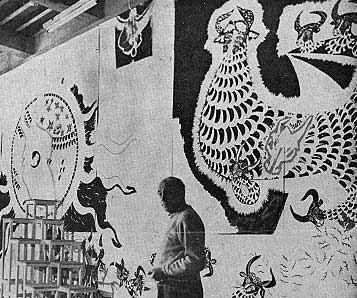
(Below) The close-up of the photo at the
bottom of the article shows another of Lurçat's innovations: The stepladder, which he
designed as a honeycomb of footstools, allowed him to have a firm footing no matter which
part of the pattern he worked on.
|
![[next page]](images/next.gif)
![[back arrow]](images/arrow.gif) Back to
the Lurçat introductory page
Back to
the Lurçat introductory page|
Copyright © 1998-2017 Times Two Publishing Company. All rights reserved. |
![[previous page]](images/previous.gif)