w w w . t i m e s t w
o p u b l i s h i n g . c o m

w w w . t i m e s t w
o p u b l i s h i n g . c o m
|
|
This image from La Poésie, part of Le Chant du Monde, the largest contemporary tapestry cycle in the world, will give you a sense of the color and scale of Lurçat's tapestries. Each of the panels in the tapestry is more than 14 feet high and up to 43 feet long. |
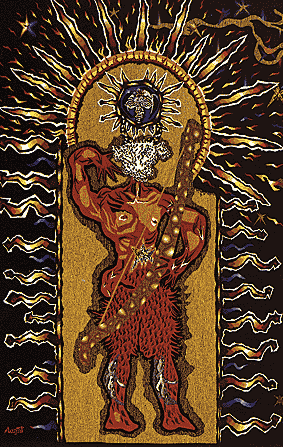
Detail from La Poésie, 1961 |
||
Panel from Le Chant du Monde, a series of ten monumental tapestries Lurçat created between 1957 and 1965 inspired by the 14th-century tapestry of the Apocalypse at Angers
|
| Moved by the Apocalypse d'Angers,
which he saw for the first time in 1937, Lurçat set out to create a modern response to
it. The Apocalypse d'Angers, completed in 1380, is the largest tapestry in the
world. It measures 740 square yards and portrays the end of the world according to the
Bible. In Le Chant du Monde, Lurçat shows his version of apocalypse: nuclear war. The first four panels illustrate the atom bomb and its destruction. In the fifth, he depicts man in harmony with nature, L'Homme en Gloire dans la Paix (Man in the Glory of Peace), his hoped-for alternative. Five more panels, including La Poésie, dominated by Sagittarius, Lurçat's symbol for the poet, "the one who hits right on," present man's creative capacity, as well as Lurçat's counterpoint to the science that created the atom bomb—the science that permitted space exploration.
|
From his
interview with William Fifield: |
![[next page]](images/next.gif)
![[back arrow]](images/arrow.gif) Back to the Lurçat
introductory page
Back to the Lurçat
introductory page|
Copyright © 1998-2017 Times Two Publishing Company. All rights reserved. |
![[previous page]](images/previous.gif)
